The ABCs of Time – Watches That Track Celestial Events
This article explores the historical development and modern execution of mechanical watches designed to track celestial events, from early astronomical clocks to sophisticated wristwatches featuring moon phases, perpetual calendars, and even orreries. It highlights the ingenuity of early clockmakers and the evolution of these complex complications.
The Prague Astronomical Clock, operational since 1410, is the oldest known mechanical tracker of celestial events, displaying the relative positions of the sun, moon, and zodiac.
Richard of Wallingford's 1330 clock could track the sun to predict moon phases and lunar eclipses, while Giovanni Dondi's 1364 Astrarium featured seven dials for the sun, moon, and five known planets.
Rudimentary moon phase indicators appeared in the early 16th century, but accurate versions in pocket watches emerged in the early 17th century, aiding sailors, travelers, and farmers.
The standard 59-tooth wheel for moon phases introduced a built-in error, causing a one-day deviation every approximately 2 years, 7 months, and 20 days.
Thomas Mudge's 1762 invention of the perpetual calendar revolutionized moon phase accuracy by using custom gear trains that compensated for month lengths and leap years, pushing deviations to one day per century.
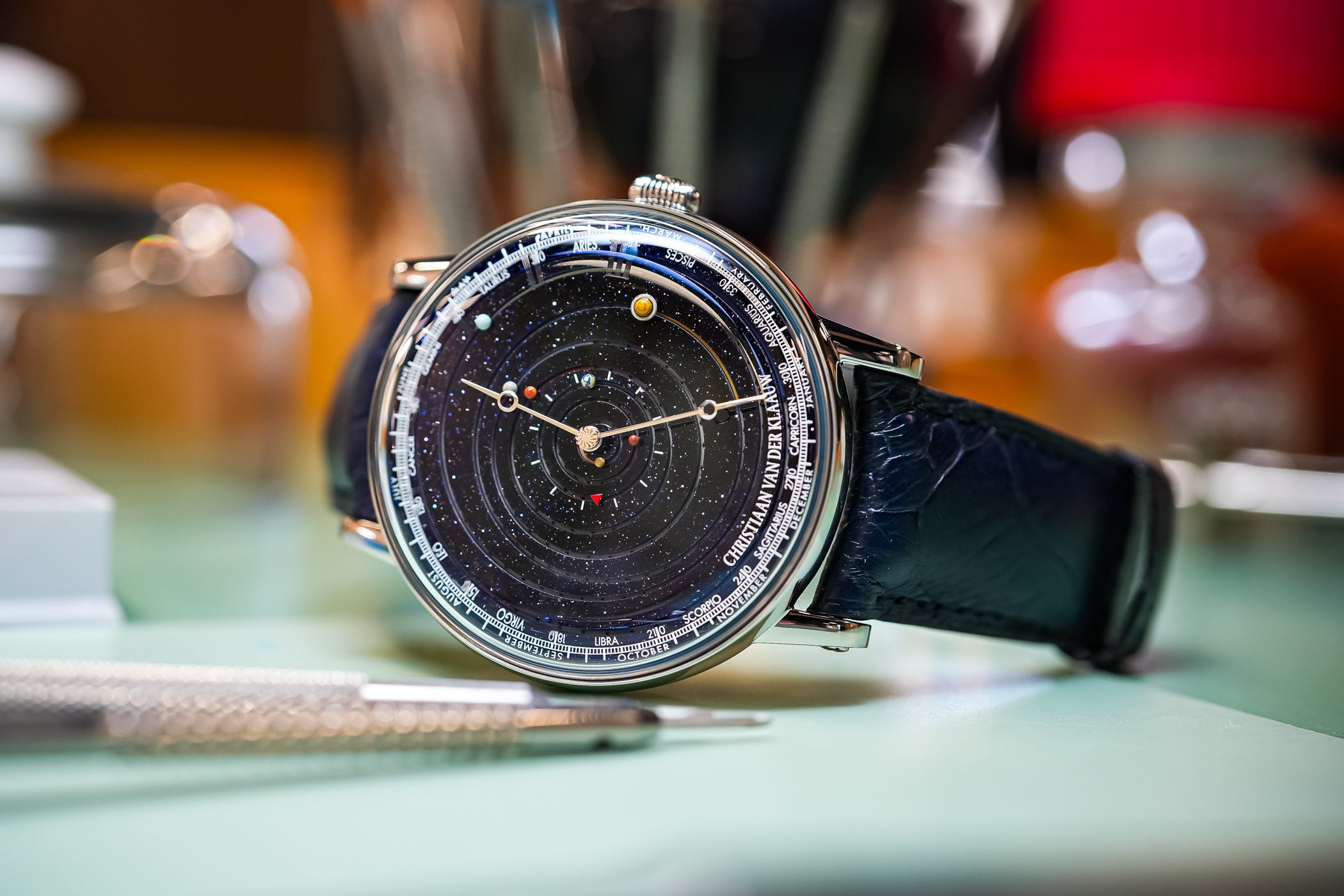
Orreries, mechanical models of the solar system, trace their roots to the Antikythera mechanism (circa 150 BC) and were later named after John Rowley's 1712 creation.
Some modern watches feature orreries, with one example detailing sub-dials that track Earth's travel distance (EARTH), the planet's solar orbit distance (SUN), and a combined orbital measurement (ORBIT).
Ulysse Nardin's Moonstruck Worldtimer is mentioned as another notable astronomical watch, following the brand's earlier astronomical trilogy.