What watch should you buy?
There are 16,071 watches from 660 brands indexed here, and most buying advice boils down to someone else's taste. Two better options: take the 2-minute quiz and let your own picks do the talking, or work the five questions below that actually decide the purchase: size, use case, movement, brand type, and what the watch is worth after you buy it.
Take the taste quiz
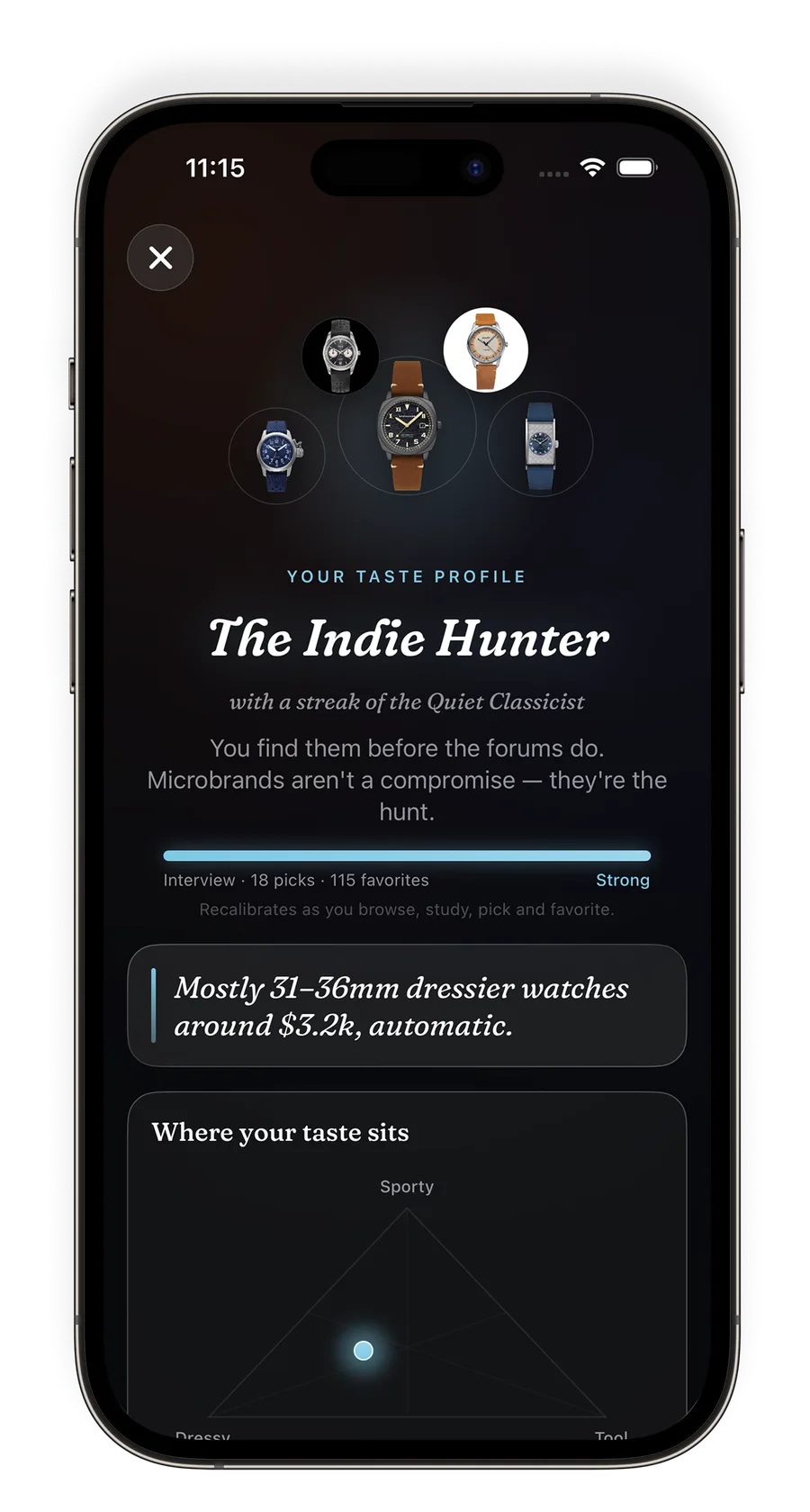
Frameworks help, but taste is faster to show than to describe. Five this-or-that picks between real watches from the catalog and the recommender starts ranking watches for your eye, not the average buyer's.
Two watches side by side: tap the one you'd rather wear. No specs to read, no forms to fill.
Each pick teaches the recommender which cases, dials, and proportions you actually respond to.
Your browse feed and recommendations re-rank around your picks. Sign in to keep the profile.
No account needed: your picks are saved on this device.
Size and fit: the spec most first watches get wrong
Case diameter gets the attention, but lug-to-lug decides the fit: if that span overhangs the flat of your wrist, the watch wears badly no matter what the diameter says. For most 6–7.5 inch wrists, 36–40 mm diameter and under 48 mm lug-to-lug is the zone. Measure your wrist before you shortlist anything, then read the sizing guide or browse only 36–40 mm watches. Every spec page here lists diameter, lug-to-lug, and thickness.
Use case: buy for the week you have
The watch you should buy matches your actual life, not the life in the ad. Swim, or want one watch for everything? A diver with 200 m water resistance. Mostly desks and weekends? A field watch or dress piece. Travel across time zones? A GMT. Undecided is fine: that is exactly what the taste quiz above is for.
Movement: the quartz reality check
A $50 quartz watch keeps better time than a $50,000 mechanical one. That is not a knock on mechanicals: it is the reason to be honest about why you are buying. Quartz: accuracy, durability, zero maintenance. Automatic: a living mechanism, the sweep of the seconds hand, and the actual point of the hobby. Manual-wind adds a daily ritual. The full trade-off (including servicing costs and power reserves) is in automatic vs quartz vs manual.
Brand type: mainstream, luxury, or microbrand
Mainstream brands (Seiko, Tissot, Hamilton) buy you service networks and easy resale. Microbrands (small independents selling direct) buy you more spec per dollar and designs nobody else at the office will own, at the cost of brand recognition and liquidity. Neither is wrong; they are different products. What is a microbrand covers the difference, and the brand index lets you compare catalogs side by side.
New vs used: retention is the hidden price tag
Two watches with the same retail price can cost wildly different amounts to own, because one holds its value and the other loses a third of it at the first resale. Before buying new, check how the model trades used: every spec page shows MSRP against used-market pricing. Do watches hold their value explains how to read the numbers, and the compare tool puts two candidates side by side, retention included.
Under $500
The quartz-vs-mechanical forkThis band buys far more watch than it did a decade ago. Sapphire crystal, 100 m water resistance, and proven movements (Seiko's 4R36, Orient's F6724) are all attainable under $500. What you give up is finishing detail and bracelet quality, not reliability.
The honest fork: if you want set-and-forget accuracy, quartz wins outright at this price: it keeps better time than any mechanical at any price. If you want the hobby (a sweeping seconds hand, an engine on your wrist you keep alive by wearing it), this is where entry automatics live, and they are genuinely good now.
$500 – $1,500
The microbrand sweet spotBetween $500 and $1,500 the spec-per-dollar equation tilts hard toward independents. Sellita SW200-1 and Miyota 9-series movements, sapphire, 200 m water resistance, and ceramic bezels become standard, often from brands like Baltic, Lorier, Nodus, or Traska that sell direct and skip the retail markup.
Mainstream Swiss competes here too: Hamilton's Khaki Field runs the 80-hour H-10 movement, and Tissot's PRX Powermatic 80 is the value benchmark of the whole segment. The choice is character and scarcity (microbrand) versus service network and resale liquidity (mainstream).
$1,500 – $5,000
Entry to the establishment: where retention starts to matterThis is the door to serious tool watches: Sinn's over-engineered German cases, Tudor's in-house movements (the Black Bay 54 runs the MT5400), Longines' true-GMT Spirit Zulu Time. Build quality stops being the question; the questions become design, brand, and what the watch is worth the day after you buy it.
Depreciation is the biggest hidden cost in this band. Before paying list, look the watch up: lug²lug tracks MSRP against used-market pricing, and two watches at the same retail price can behave very differently once worn.
$5,000 and up
Buy the specific watch, not the tierPast $5,000 every watch is well made; you are paying for movement architecture, brand equity, and liquidity. This is where buying used deserves real consideration: a watch that holds 60% of list is a fundamentally different purchase from one that holds 95%, and the spread between an Omega and a steel-sports Rolex on the secondary market is the clearest example in the industry.
The framework still applies: size and fit first, use case second. A grail that sits in a drawer because it wears too big is a worse buy than the $700 watch you reach for daily.
Diver
3,386 in the catalogThe default first serious watch for a reason: 200 m water resistance, a rotating timing bezel, and legibility that works everywhere from the office to the ocean. If you only own one watch, a 38–41 mm diver is the safest call in the hobby.
Field
890 in the catalogMilitary-derived, small, light, and legible: the easiest watch to wear daily and the cheapest path to a genuinely good mechanical. Field watches run smaller (36–40 mm), which suits most wrists better than the spec sheet suggests.
Dress
2,709 in the catalogThin, simple, on leather or an integrated bracelet: the watch for cuffs and occasions. If your week is more keyboard than trail, a dress or dress-sport piece will get more wrist time than the tool watches that dominate the discourse.
GMT
674 in the catalogA second time zone on a fourth hand: the travel complication. True GMTs (independently-set local hour) used to start at Swiss-luxury prices; movements like the Miyota 9075 and Seiko NH34 have pushed them under $800.
Chronograph
1,599 in the catalogThe stopwatch complication, and the best-looking dial layout in watchmaking. Mechanical chronographs get expensive fast; meca-quartz movements deliver the sweeping reset and vintage looks for a fraction of the price.
What watch should I buy first?
Work through three decisions in order: budget band, size, and use case. Under $500, pick between a quartz watch (better accuracy, zero maintenance) and an entry automatic like the Seiko 5 Sports or Orient Bambino. Size matters more than most buyers expect: 36–40 mm diameter with a lug-to-lug under 48 mm fits the majority of wrists. Then match the category to your actual week: a diver or field watch if you want one watch for everything, a dress piece if your days are desks and dinners.
What is the best first automatic watch?
The consensus entry points are the Seiko 5 Sports (4R36 movement, hackable and hand-windable), the Orient Bambino (in-house F6724, the classic dress option), and, a step up, the Tissot PRX Powermatic 80 with its 80-hour power reserve. All three use proven movements that any watchmaker can service. Microbrand alternatives like the Baltic Aquascaphe or Lorier Neptune trade the service network for better spec-per-dollar and more distinctive design.
Is quartz or automatic better for a first watch?
Quartz is objectively better at being a watch: more accurate than any mechanical movement at any price, no servicing, no winding. Automatic is better at being a hobby: a live mechanism you can feel and hear, a sweeping seconds hand, and the thing most collectors are actually here for. If you are buying one watch to tell time, buy quartz. If this purchase might be the first of several, buy the automatic: it is the difference between owning a watch and getting into watches.
How much do I need to spend to get a good watch?
Less than the hobby's discourse suggests. Sapphire crystal, 100 m water resistance, and a reliable movement are all available under $500. Between $500 and $1,500 you reach Swiss workhorse movements, 200 m divers, and the strongest value segment in the market: the microbrands. Above that you are buying refinement, brand, and resale behavior, not reliability.
Should I buy new or used?
Check the retention number first. Most watches trade below retail on the used market, which makes lightly-used the rational default for depreciating models: someone else absorbs the drop. The exceptions are watches trading at or above list (certain steel sports models and sold-out microbrand runs), where buying new at retail is the deal. lug2lug tracks MSRP against used-market prices on every spec page so you can see which case you are in before you pay.