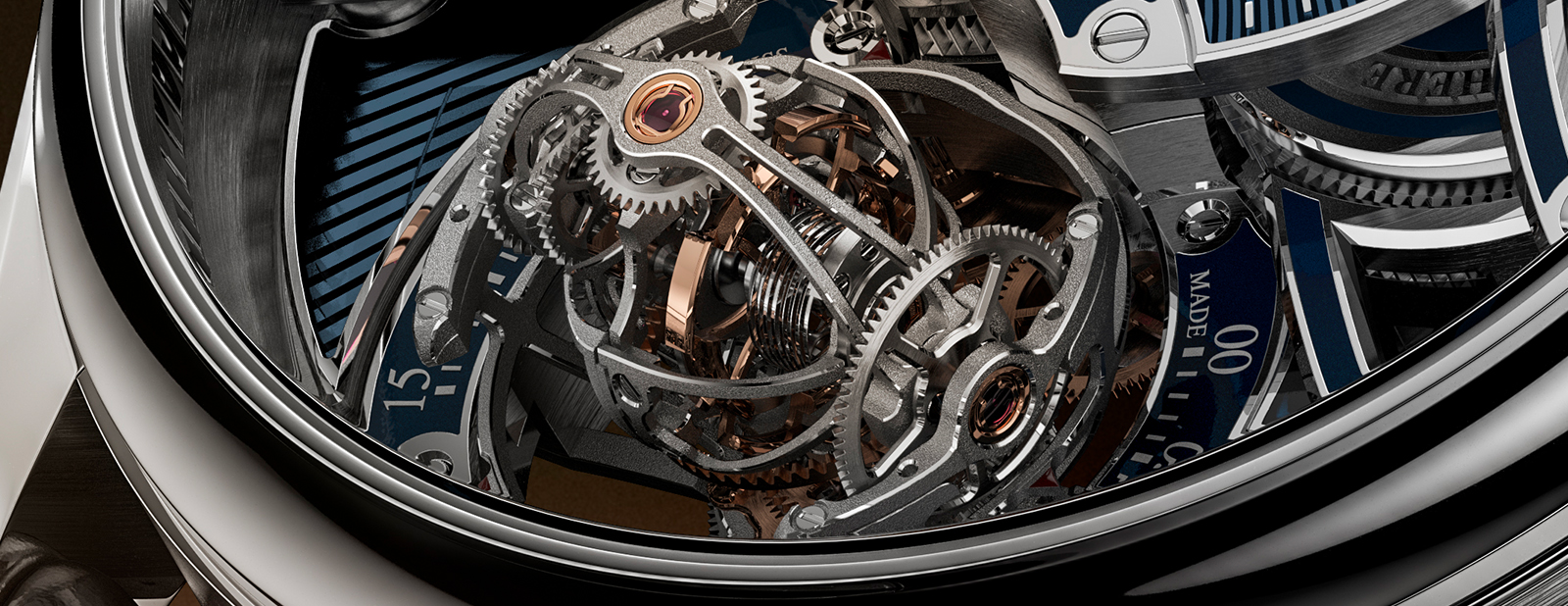
The Complete Story of the Multi-Axis Tourbillon
This editorial traces the historical evolution of the multi-axis tourbillon, from its origins as a solution to gravity's effects on mechanical watches to its modern interpretation as a kinetic sculpture in haute horology. It highlights key milestones, including early double-axis concepts, the "long silence" before its revival, and the breakthroughs by various watchmakers that redefined the complication.
The multi-axis tourbillon's development is framed as a battle against gravity, an "invisible demon" that affects the accuracy of mechanical wristwatches.
Abraham-Louis Breguet is credited with inventing the tourbillon, a revolving cage designed to counteract gravity's errors by moving the escapement and balance through various positions.
Girard-Perregaux's "Three Golden Bridges" from 1889, crafted by Ernest Guignard, is cited as an example of early architectural beauty and performance in tourbillon watchmaking.
Omega created twelve wristwatch tourbillon movements, Calibre 301, in 1947 specifically for observatory competitions.
The Quartz Crisis led to a decline in tourbillon production, but the complication saw a resurgence in the 1980s and '90s, shifting its focus from pure chronometry to "emotional theatre" and "performance art."
Audemars Piguet's 1986 Reference 25643, featuring the Calibre 2870, was the first wristwatch tourbillon to place the complication dial-side, making it a visual focus.
The Audemars Piguet Ref. 25643 remained the world's thinnest self-winding tourbillon at 4.8mm until the Bvlgari Octo Finissimo Tourbillon Automatic in 2018 (3.95mm).