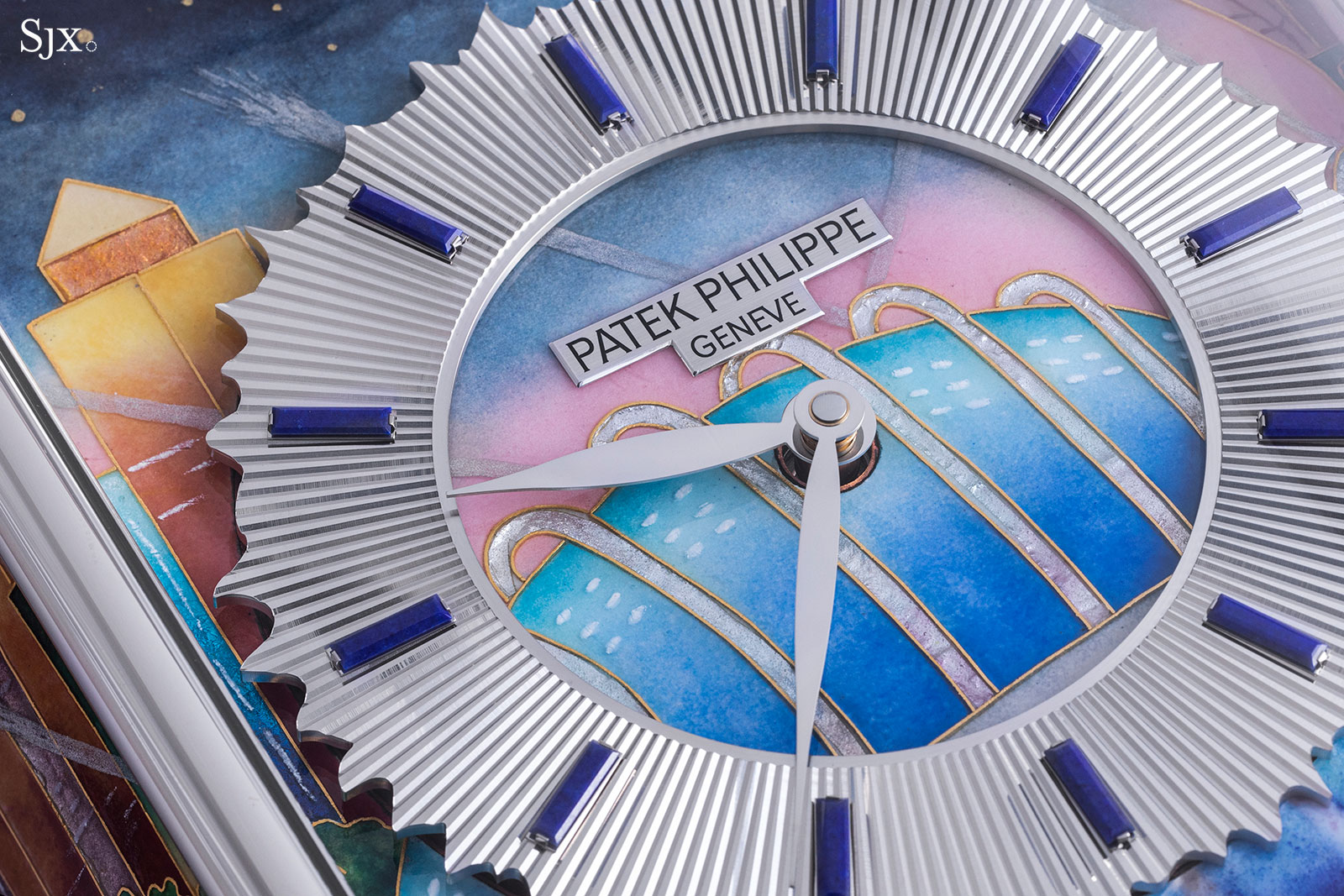
Patek Philippe has been a significant patron of cloisonné enamel for nearly a century, helping to preserve the craft when its popularity waned. The brand's commissions, from early world time watch dials to modern artisanal pieces, highlight the evolution of both the technique and the recognition of the artists involved. Recent auction results underscore the high demand for these unique dials, with a 1953 ref. 2523 featuring a South America map selling for over $10 million.
- Cloisonné enamel dials have a long history at Patek Philippe, dating back to the 1930s.
- The technique involves using gold wire to create compartments filled with colored glass enamel.
- Patek Philippe commissioned independent enamellers, notably through its supplier Stern Frères, for map-themed dials.
- Louis Cottier's Heures Universelles system provided the basis for many world time watch dials featuring enamel maps.
- Examples include pocket watches (ref. 605 HU) and wristwatches (ref. 1415 HU, ref. 2523).
Cloisonné enamel involves bending gold wire, sometimes as thin as 0.05 mm, to form designs on a dial, which are then filled with ground glass and metal oxides.
The process requires repeated firings in a kiln at around 800°C, with each firing risking imperfections and requiring careful color layering.
Patek Philippe's patronage extended to allowing artists to sign their dials, acting as a curator of enamel art.
Early cloisonné dials at Patek Philippe often featured geographical maps, originating from Louis Cottier's world time watch system.
Pocket watches like the ref. 605 HU (approx. 95 made between 1938-1964) were among the first to feature enamel dials, with only about a dozen having them.
The ref. 1415 HU, introduced in 1939, was the first series-produced world-time wristwatch to feature cloisonné map dials.
The ref. 2523, appearing in the 1950s, was larger at approximately 36 mm and featured two crowns for time setting and city ring adjustment.
A pink-gold ref. 605 HU from 1943 with a world-map dial sold for approximately CHF 3.13 million in 2024, representing an early enamel example in private hands.