The Complete Story of the Inclined Tourbillon | Masters of Chronometry EP 3
This episode of Masters of Chronometry explores the evolution of the inclined tourbillon, a complication designed to address the positional errors of traditional tourbillons when a watch is not kept in a vertical orientation. The narrative traces this concept from its 19th-century American origins with Andrew Holden Potter, through Walter Prendel's advanced six-minute tourbillon, to modern interpretations by Greubel Forsey and other contemporary watchmakers.
The inclined tourbillon addresses the problem of positional errors in traditional tourbillons, which were conceived for pocket watches kept vertically.
Andrew Holden Potter, a Boston watchmaker, is credited with creating an early inclined-balance tourbillon in the 19th century.
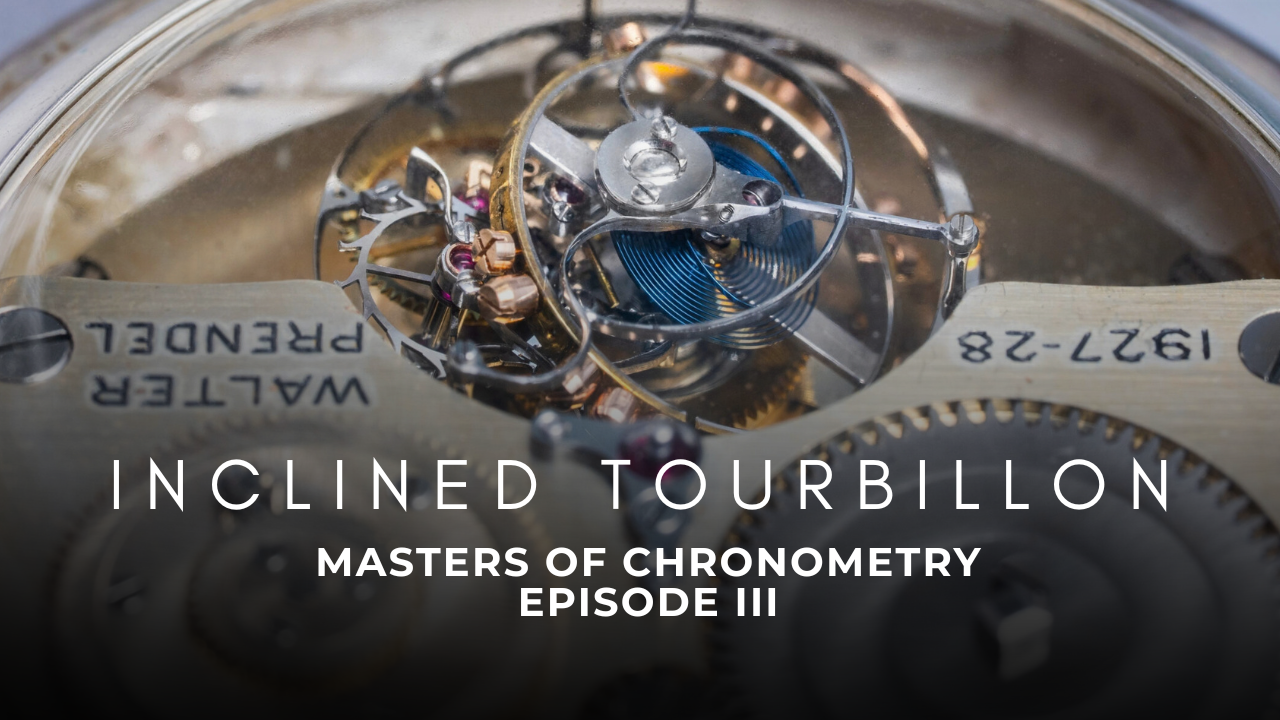
Walter Prendel developed a six-minute tourbillon with progressively inclined escape wheel, pallet fork, and balance.
Greubel Forsey's Double Tourbillon 30° translated the inclination principle to wristwatches and achieved a high score at the 2011 Concours International de Chronométrie.
The episode also examines other inclined tourbillon developments, including Greubel Forsey's Tourbillon 24 Secondes and Tourbillon Cardan, Éric Coudray's work, HYT's Conical Tourbillon, Jaeger-LeCoultre's Heliotourbillon, and ArtyA's Complexity.