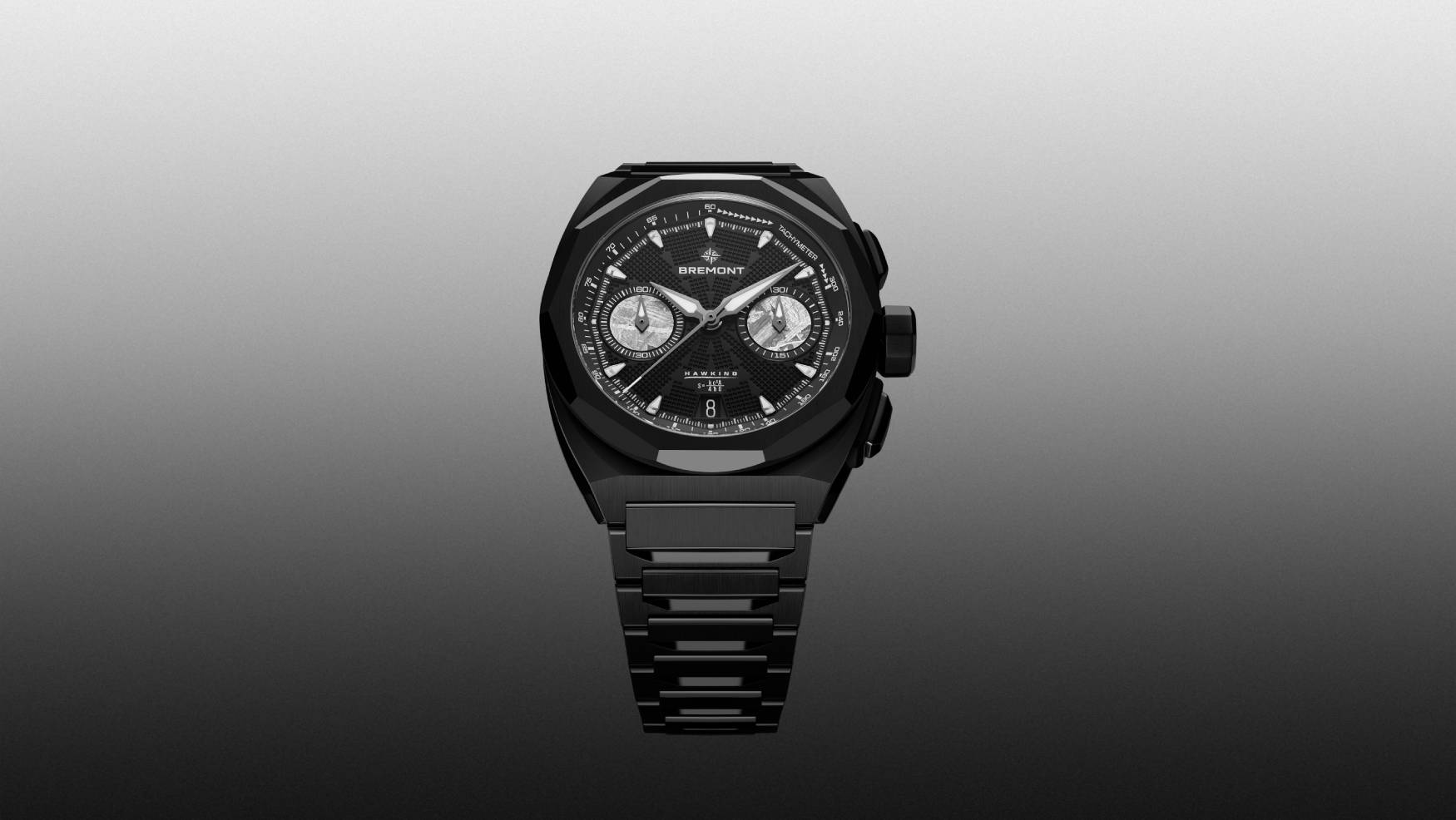
Bremont Supernova Hawking Limited Edition
Bremont has launched the Supernova Hawking Limited Edition, a new chronograph built on the Supernova platform and inspired by the scientific work of Professor Stephen Hawking, particularly his research into black holes. This second collaboration with the Hawking family features a dark, space-themed aesthetic with meteorite subdials and a black hole motif on the caseback.
- Limited to 600 pieces
- Price: GBP 7,950
- Price: US$8,850 (on rubber strap)
- Price: US$9,150 (on bracelet)
- Available beginning July 26, 2026
The watch's geometric case, pushers, and crown are designed to reflect Hawking's work in space engineering, specifically his research into black holes.
The dial features an interlocking, galvanic black grid motif inspired by the design of solar arrays on spacecraft.
Two meteorite subdials are present at 3 and 9 o'clock, providing balance and layering to the dial.
The exhibition caseback features a swirling black hole motif above the chronometer-rated BC77 movement.
The watch includes Hawking's name and the Bekenstein-Hawking entropy formula above the day-date window at 6 o'clock.
The BC77 movement is chronometer-rated, based on the Sellita SW500, and features a Glucydur balance, Anachron hairspring, and Nivaflex mainspring.
The case utilizes a layered construction, recalling Bremont’s iconic Trip-Tick case design.
The dial design is inspired by spacecraft solar arrays, with triangular pathways drawing the eye towards the center.
