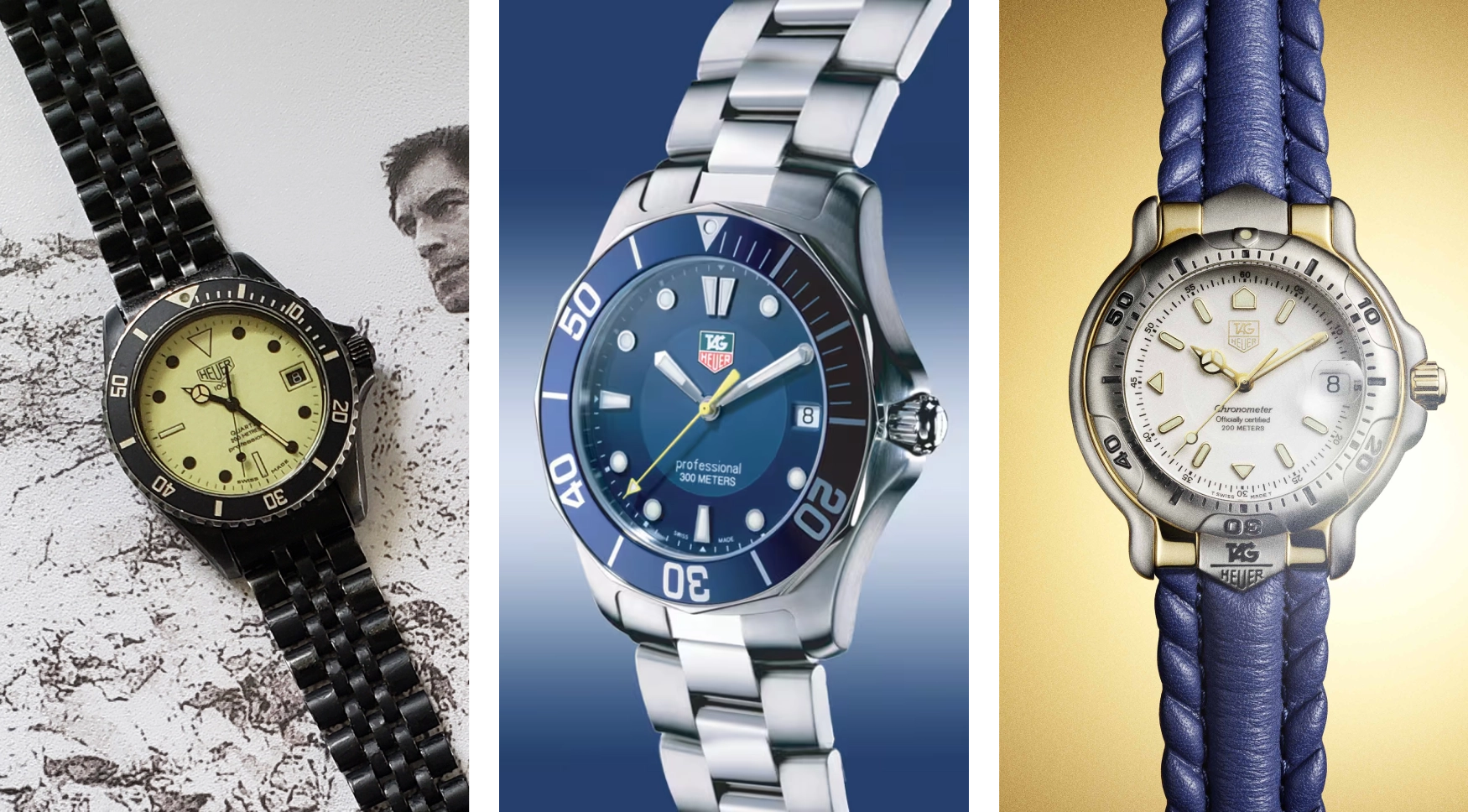

This article traces the complete lifecycle of TAG Heuer's dive watch collection, from its inception in 1978 as a response to market demand for sturdy, quartz-powered divers, through its evolution in the 1980s and 1990s, to its current status as the best-selling Aquaracer line. It highlights key historical models and design influences, including the Heuer ref. 844 and the 2000 Series, and discusses the brand's strategic decisions in developing its professional dive watch offerings.
Jack Heuer's motivation for entering the dive watch market stemmed from conversations at the ISPO trade fair in the late 1970s, where he learned of difficulties other companies had sourcing reliable private-label dive watches.
Early Heuer dive watches, like the ref. 844 from 1978, were inspired by the Rolex Submariner in dial layout and hand design, but offered a more competitive price point and various sizes.
The ref. 844 utilized movements from France Ebauches, cases from MRP SA, and assembly by Georges Monnin, with some examples featuring "Swiss Made" text and others not, depending on production location.
The 2000 Series, launched in 1982, aimed to break dive watch conventions with varied bezel and dial designs, two-tone options, and the adoption of Mercedes-style hour hands, moving away from the earlier cathedral style.
The 1000 Series, officially named from 1984 to 1991, adhered to strict utility standards including 200m water resistance, a screw-down crown, a folding safety clasp, a unidirectional bezel, sapphire crystal, and lumed indices.