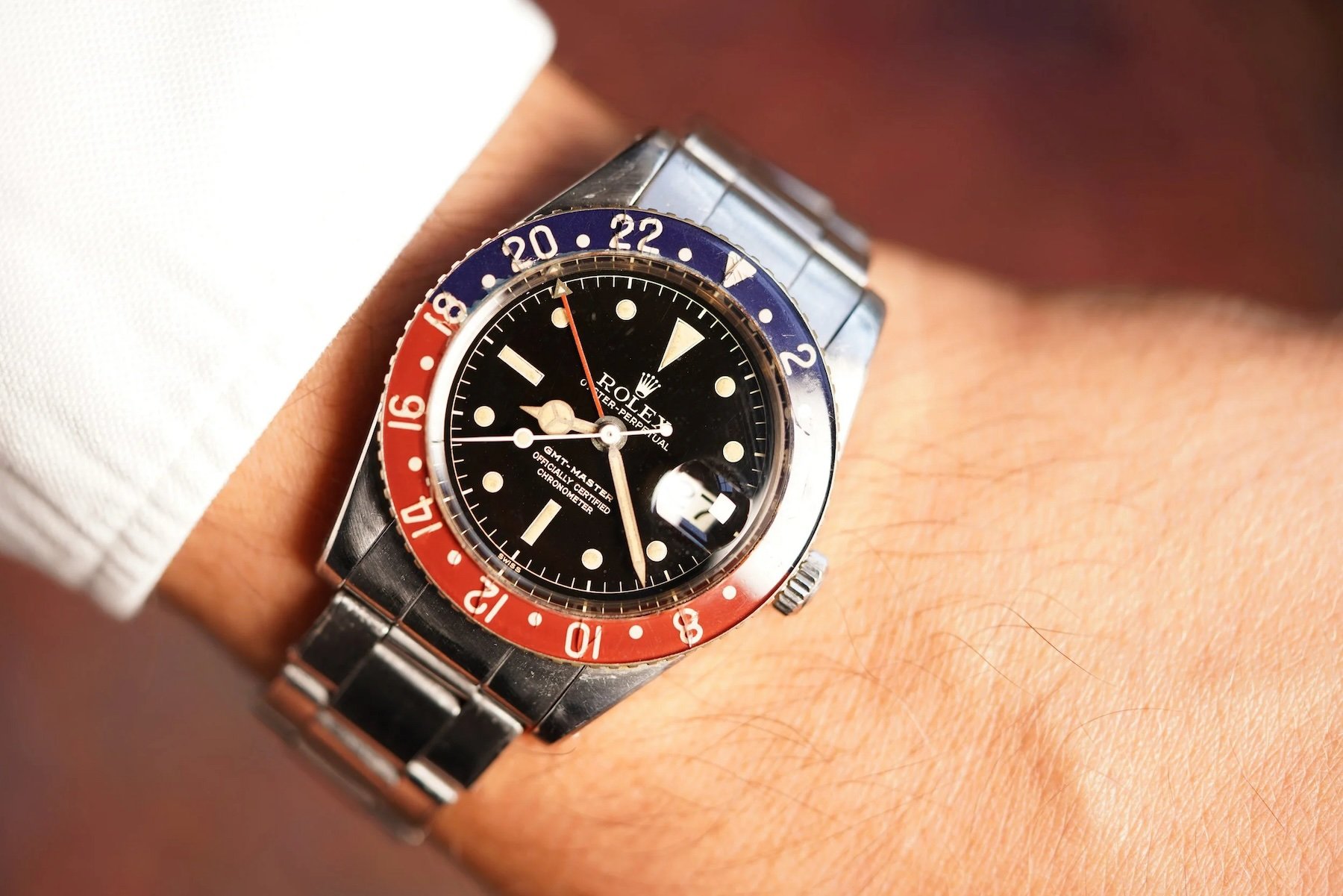
This article delves into the history of the Rolex GMT-Master ref. 6542, focusing on its controversial luminous Bakelite bezel. Initially lauded for its innovative design, the watch gained notoriety when its strontium-90-infused bezel was found to be radioactive, leading to a recall and prompting industry-wide investigations into radiation safety in watchmaking.
- Steel version retailed for US$240
- Gold version retailed for US$600
- Rolex signed an agreement with Pan American Airways in December 1959
The Rolex GMT-Master ref. 6542 featured a distinctive red-and-blue 24-hour bezel, nicknamed the "Pepsi," and an additional 24-hour hand for tracking a second time zone.
Rolex filed patent applications for its luminous plastic bezel in January 1955 and for a 24-hour-hand mechanism linked to the date display in May 1955.
The original luminous bezel insert contained strontium-90, a radioactive isotope derived from nuclear fission and fallout.
Following the controversy, Rolex replaced the luminous Bakelite bezel with a non-luminous aluminum version.
The bezel controversy contributed to the watch industry's transition away from radium-based luminous materials towards safer alternatives like tritium.
The GMT-Master ref. 6542's radioactive bezel was referenced in the 1961 James Bond novel "Thunderball."